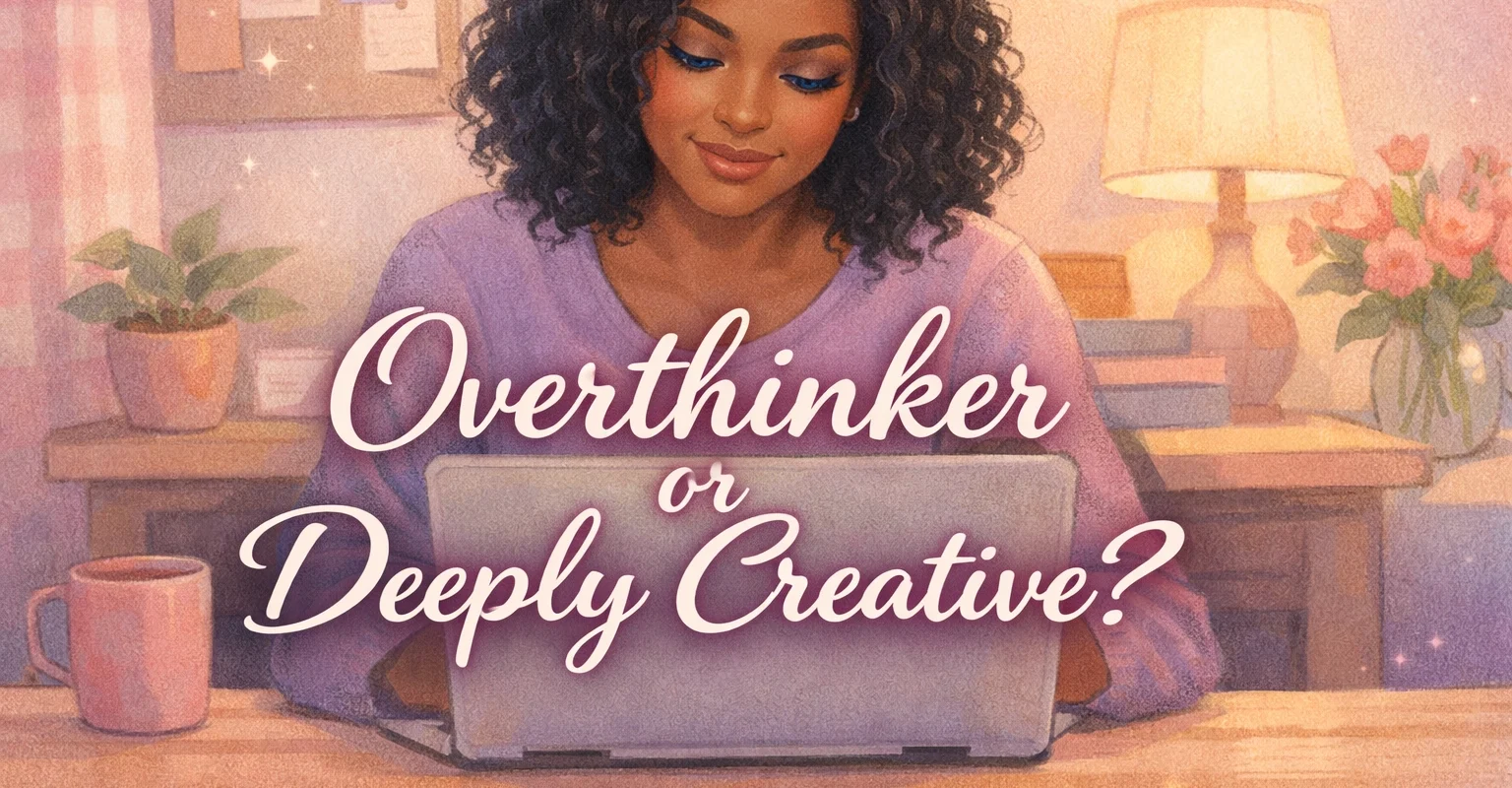
You’re lying in bed at 2 AM, mind spinning through seventeen different versions of tomorrow’s conversation. Or you’re staring at a blank page, imagining every possible way your idea could fail before you’ve even started.
And then comes the question that haunts you: Is this creative depth or am I just broken?
Here’s what nobody tells you: you might be both deeply creative and chronically overthinking. And neither one makes you broken.
The Truth About Creative Minds and Overthinking
There’s a reason your brain won’t shut off. Research shows that the same part of your brain responsible for self-generated thought, the kind that fuels creativity, imagination, and original thinking, is also highly active in people prone to anxiety and rumination.
In other words, your tendency to overthink isn’t a flaw. It’s the same mechanism that makes you creative.
Creative people naturally ruminate longer on problems than others. You turn ideas over in your mind like stones, examining every angle, every possibility. This is what helps you see connections others miss. This is what fuels your art, your writing, your unique way of moving through the world.
But here’s where it gets tricky: that beautiful creative depth can tip into anxious overthinking without you even noticing the shift.

The Difference Between Deep Thinking and Overthinking
Deep thinking feels calm. Grounded. Even when you’re wrestling with something complex, there’s a quality of curiosity to it. You’re exploring, considering, moving toward understanding.
You’re planning a creative project and you envision how the pieces might come together. You feel excitement mixed with productive problem-solving. You’re imagining possibilities.
Overthinking feels scattered. Anxious. You’re caught in a loop, circling the same worries without moving toward resolution.
You’re planning the same project but now you’re obsessing over whether anyone will like it, whether you’re good enough, whether you should even bother. You’re imagining disasters.
Here’s the key distinction: deep thinking is solution-focused. Overthinking is stuck in the problem.
When you’re thinking deeply, you’re moving the needle forward. When you’re overthinking, you’re spinning your wheels in the same rut, wearing it deeper.
How to Tell Which One You’re Doing
Your body knows before your mind does.
Deep creative thinking might feel intense, but there’s usually a quality of aliveness to it. Maybe some productive tension. Your chest is open. You’re engaged.
Overthinking creates anxiety. Tightness in your chest or throat. A sense of dread or heaviness. Your shoulders creep up toward your ears. You feel like you’re bracing for impact.
Another signal: ask yourself if you’re actually making progress or just rehearsing the same scenarios on repeat.
If you’re exploring new angles, considering different approaches, or moving toward a decision, even slowly, that’s productive thinking.
If you’re replaying the same conversation for the fortieth time, imagining the same worst-case scenario, or spiraling through the same self-doubt loop without gaining new insight, you’ve tipped into overthinking.

Why You’re Allowed to Stop
You don’t have to earn the right to let your mind rest.
You don’t have to solve every problem before you’re allowed peace.
You don’t have to figure it all out tonight.
The voice that tells you if I just think about this enough, I’ll find the answer is trying to keep you safe. It believes that if you can anticipate every problem, imagine every outcome, prepare for every contingency, you’ll be protected.
But you can’t think your way to safety. And exhausting yourself trying doesn’t make you more prepared, it just makes you more tired.
How to Stop Overthinking (Even When Your Brain Won’t Quit)
Notice When You’ve Crossed the Line
The first step is always recognition. You can’t shift what you can’t see.
Start paying attention to the quality of your thinking. Is this moving me forward or keeping me stuck? Does this feel productive or punishing?
You don’t have to judge it. Just notice. Oh, I’m overthinking right now.
That simple acknowledgment creates space. It interrupts the automatic loop.
Give Your Worries Office Hours
Here’s a practice that sounds too simple to work, but it does: schedule specific times for problem-solving.
Set aside 15-20 minutes daily (or a longer session weekly) where you deliberately think about whatever’s bothering you. Write it out. Explore solutions. Let yourself spiral if you need to: but only during this designated time.
Outside those hours, when the anxious thoughts show up, you tell them gently: I hear you. We have time set aside for this. I’ll think about it then.
It sounds ridiculous until you try it. But giving your brain a container for worry often helps it relax the rest of the time.

Redirect Your Focus to the Present
Overthinking pulls you into the future (all the things that might go wrong) or the past (all the things you should have done differently).
The present moment is the only place where you’re actually safe.
When you catch yourself spiraling, come back to now. Feel your feet on the ground. Notice three things you can see. Take one slow breath.
You’re not trying to make the thoughts go away. You’re just reminding yourself where you actually are.
Move Your Body
Overthinking happens in your head. Sometimes the fastest way out is through your body.
Dance for one song. Walk around the block. Stretch. Do jumping jacks. Anything that shifts your physical state.
Movement interrupts the mental loop and brings you back into your body, where you’re allowed to just exist without solving anything.
Journal Prompts for Self Discovery (When You’re Stuck in Overthinking)
Sometimes you need to write your way through it. Here are some journal prompts for self discovery that can help you distinguish between productive thinking and anxious spinning:
- What am I actually trying to solve right now? (If you can’t name it clearly, you’re probably overthinking.)
- What would I do if I trusted myself completely?
- What’s the smallest next step I could take, even if I don’t have the whole path figured out?
- What am I feeling in my body right now? Where is the tension?
- If this worry were trying to protect me, what would it say it’s protecting me from?
- What would I tell my best friend if they were struggling with this same thing?
Write without editing. Let whatever comes up come up. You’re not trying to arrive at perfect answers: you’re trying to move the stuck energy.

The Practice of Returning
Learning how to stop overthinking isn’t about never overthinking again. You will. Your creative, sensitive mind will continue to spin out sometimes.
The practice is in how quickly you notice and how gently you return.
You don’t shame yourself for overthinking. You don’t add “and now I’m overthinking about overthinking” to the pile.
You just notice. Redirect. Come back to now. Again and again.
That’s the whole practice. Return. As many times as it takes.
You’re Not Broken. You’re Sensitive.
Your overthinking isn’t evidence that something’s wrong with you. It’s evidence that you feel deeply, care deeply, and process the world in complex, nuanced ways.
The same quality of mind that exhausts you with worry is the same one that creates beauty, notices subtlety, and connects dots others miss.
You don’t need to eliminate your depth. You just need to learn when it’s serving you and when it’s spinning out. And then practice: gently, repeatedly: guiding yourself back to center.
Your creativity needs your deep thinking. It doesn’t need your anxious overthinking.
You’re allowed to protect your peace while honoring your depth.
Want to Go Deeper?
If you’re tired of the mental loops and ready for support in learning how to trust yourself and your creative process, I’d love to work with you.
The Unfold Session is a 90-minute deep dive where we explore what’s keeping you stuck and create a personalised path forward: one that honors both your creativity and your need for peace.
Or if you’re ready for ongoing support, Unapologetically You offers six weeks of guided coaching to help you build self-trust, quiet your inner critic, and express yourself more freely.
And if you’re not ready for coaching yet, grab the Authentic Expression Starter Kit: a collection of journal prompts, creative exercises, and gentle practices to help you reconnect with yourself.
You don’t have to figure this all out alone. And you don’t have to exhaust yourself trying.
Let’s create some space for your mind to rest and your creativity to breathe.
https://mariaduckhouse.com | Let’s connect on Instagram
Still here? come on… join me over on Instagram where I share more thoughts on creative living, self-trust, and gentle growth.
Buy me a coffee