You know that feeling when you doubt every decision you make? When you check in with five people before doing the thing you already know you want to do. When you second-guess yourself so often it becomes background noise. When you’re waiting for some magical moment of clarity that never arrives. That’s not a character flaw. That’s what happens when self trust has been eroded, slowly, over years of people-pleasing, silencing your own voice, and learning that other people’s opinions matter more than your own inner knowing.
Here’s the truth: You don’t need a dramatic breakthrough to build self trust. You need tiny, repeated proof that you can trust yourself.
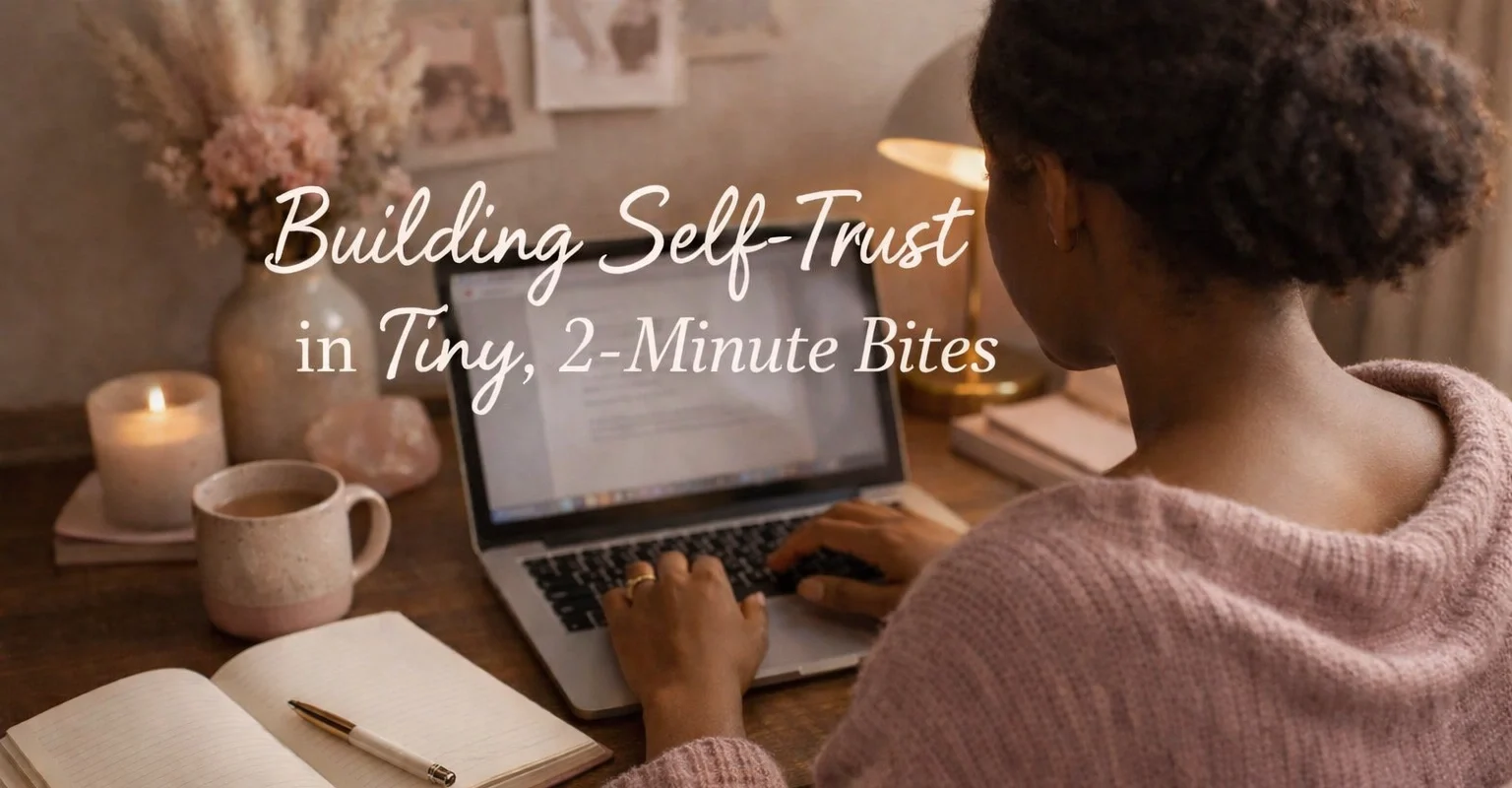
And that starts in 2-minute bites.
Why 2 Minutes Self Trust Habit Actually Works

When you’re someone who overthinks everything, the idea of “building self-trust” can feel massive and overwhelming. Where do you even start? How do you suddenly become someone who trusts their gut after years of doubting it?
You don’t.
You start small. So small it feels almost silly. Because self trust isn’t built through grand gestures, it’s built through repeated small actions.
Every time you honor a tiny commitment to yourself, you’re creating evidence. Evidence that you follow through. Evidence that you listen to your own needs. Evidence that you can handle things.
Two minutes is short enough that your overthinking brain doesn’t have time to talk you out of it. And it’s long enough to actually do something meaningful.
The 2-Minute Practices That Build Self Trust
Here are simple ways to practice how to build self trust, no willpower required, no life overhaul needed.
Say No to One Small Thing
Today, decline something minor.
A social invite you don’t have energy for. An extra task someone assumes you’ll take on. A suggestion that doesn’t feel right.
You’re not practicing cruelty. You’re practicing boundaries. You’re demonstrating to yourself that your needs and limits are worth honoring.
Each time you say no without apology, you’re telling your nervous system: I trust myself enough to protect my energy.

Do One Small Hard Thing
Pick something that makes you hesitate. Not something impossible, something that just feels slightly uncomfortable.
Send the email. Make the phone call. Post the thing you’ve been overthinking.
Take a breath. Count to five. Do it before your brain catches up.
This isn’t about being fearless. It’s about building evidence that you can handle discomfort and still be okay on the other side.
Replace One Self-Critical Thought
Catch yourself mid-spiral.
When that harsh inner voice shows up (and it will), pause. Ask yourself: Would I say this to a friend?
Then say something kinder. Not fake-positive. Just… kinder.
“You’re such a mess” becomes “You’re having a hard moment.”
“You always mess this up” becomes “You’re learning.”
You don’t have to believe it fully yet. You’re just practicing a different voice. One that might actually help you build self trust instead of tearing it down.
The Body Knows Before the Brain Does

Here’s something most advice about self trust misses: Your body is where trust lives.
Not in your head. Not in your thoughts. In the quiet signals your body sends before your brain gets involved.
Spend two minutes noticing.
Where’s there tension? Where’s there ease? What does “yes” feel like in your body? What does “no” feel like?
You don’t need to analyze it. Just notice.
Over time, this practice reconnects you with your inner knowing, the part of you that’s been trying to guide you all along, underneath all the overthinking.
Write One Line of Evidence
At the end of the day, write down one thing you did that you’re quietly proud of.
Got outside for five minutes. Said what you actually thought. Didn’t check your phone first thing in the morning. Chose the thing that felt aligned instead of the thing that looked impressive.
This isn’t a gratitude journal. This is an evidence log.
You’re collecting proof that you can trust yourself. That you are trustworthy. That you follow through, even in small ways.
Visualize One Successful Outcome
Instead of catastrophizing (which, let’s be honest, you’re probably really good at), spend two minutes imagining something going well.
Not in a fake, toxic-positivity way. In a grounded, “what if this actually works out?” way.
Picture yourself handling the conversation calmly. See the project coming together. Imagine feeling settled in your decision.
You’re not manifesting. You’re just giving your brain a different story to rehearse. One where you trust yourself and things turn out okay.
What Happens When You Keep Going

Here’s what shifts when you practice how to build self trust in 2-minute increments:
You stop asking everyone else for permission. You notice what you actually want before polling the group. You make decisions faster because you’re not spiraling through every possible outcome.
You start to feel steadier. Less reactive. More like yourself.
Not overnight. Not dramatically. Just… gradually. Like roots growing deeper.
And one day you’ll realize: You’ve been trusting yourself without even noticing.
When You’re Ready to Go Deeper
If these 2-minute practices are resonating and you’re craving more support, the Authentic Expression Starter Kit is a gentle place to begin. It’s designed for deep-feeling creatives who want to reconnect with their voice: softly, at their own pace.
And if you’re ready for something more personalized, the Unfold Session is a one-time deep dive where we work together to untangle what’s blocking your self trust and create a clear, manageable path forward. Or, if you want ongoing support, Unapologetically You coaching gives you the structure and space to rebuild self trust week by week, without pressure or performance.
You don’t have to have it all figured out to start. You just have to start somewhere.
Even if it’s just two minutes.
Soulfully, Maria
https://mariaduckhouse.com | Let’s connect on Instagram
Buy me a coffee