 Maria Duckhouse
You know the drill by now.
Someone asks for your help, and you say yes before you even check if you have the time. You make plans with yourself, to rest, to create, to just be, and then you cancel them the moment someone else needs something. You’ve spent so long putting others first that you’re not even sure what your own voice sounds like anymore.
And now? Now you’re trying to build self trust in a nervous system that’s been trained to abandon you.
Here’s what no one tells you: self trust isn’t built through big, dramatic declarations. It’s built in five-minute increments. Through tiny promises you actually keep. Through small acts of choosing yourself that your body starts to believe.
If you’ve always put others first, this is how you start coming home to yourself.
Why Self Trust Feels Impossible When You’re a People-Pleaser
Let’s be honest about what’s really happening here.
Every time you said yes when you meant no, you taught yourself that your needs don’t matter. Every time you canceled on yourself to show up for someone else, you reinforced the belief that you’re not worth keeping promises to. Every time you ignored your exhaustion, your boundaries, your quiet inner voice, you broke trust with yourself.
Not because you’re weak. Not because you’re broken.
Because people-pleasing is how you learned to stay safe.

When you grow up sensitive, when you feel everything deeply, when your nervous system picks up on every shift in the room, you learn quickly that other people’s comfort equals your safety. So you adapt. You become the person who makes everyone else feel okay, even if it costs you your own sense of self.
But here’s the part that matters: what kept you safe then is keeping you stuck now.
You can’t build self trust while simultaneously abandoning yourself to keep others comfortable. You can’t learn to rely on yourself if you’re still teaching your nervous system that everyone else’s needs come first.
The good news? Self trust can be rebuilt. Five minutes at a time.
The 5-Minute Daily Practice That Changes Everything
Forget the hour-long morning routines and elaborate self-care rituals. If you’ve spent years people pleasing, your nervous system needs proof that you’re trustworthy, and it needs that proof in small, consistent doses.
Here’s what actually works:
Make one tiny promise to yourself each day. And keep it.
That’s it. That’s the foundation of how to build self trust.
Not a big promise. Not a life-changing commitment. Just one small thing that’s entirely for you.
Maybe it’s:
- Taking a 15-minute walk, no phone allowed
- Drinking a full glass of water before you check your email
- Spending 5 minutes sketching or journaling before bed
- Saying no to one thing that drains you
- Sitting in silence with your morning coffee instead of scrolling
The specific action doesn’t matter nearly as much as the follow-through. Because every time you keep a promise to yourself, you’re sending a message to your nervous system: You matter. Your needs matter. I’m not abandoning you today.
And slowly, so slowly you might not even notice at first, you start to believe it.
Your 5-Minute Self Trust Toolkit
Here are five practices you can rotate through. Pick one each day. Keep it simple. Keep it doable.
1. The Strength Acknowledgment (2 minutes)
Before you get out of bed or while you’re brushing your teeth, name three things you’ve overcome or accomplished recently. They don’t need to be big. “I asked for help when I needed it.” “I finished that project even though I was scared.” “I rested when my body asked me to.”
This isn’t about toxic positivity. It’s about redirecting your attention to evidence that you’re capable. When you’ve spent years focusing on everyone else’s needs, you forget your own strength. This practice reminds you.
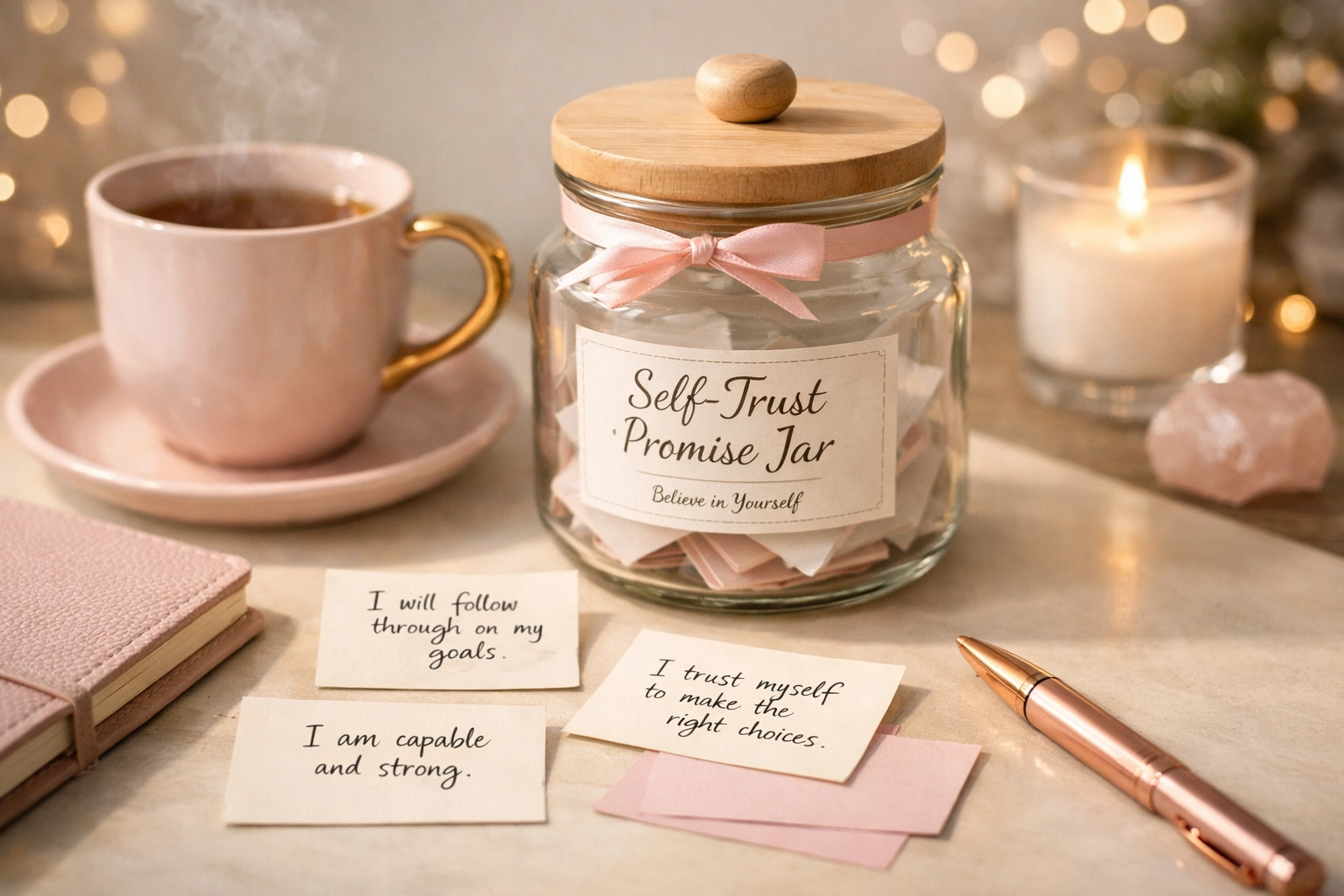
2. The Self-Trust Jar (1 minute)
Keep a jar on your desk or bedside table. Each day, write one moment when you chose yourself, no matter how small, and drop it in. “Said no without over-explaining.” “Took a break instead of pushing through.” “Asked for what I needed.”
You’re creating physical proof that you’re learning to trust yourself. And on hard days when people-pleasing feels easier, you can read those notes and remember: you’ve done this before. You can do it again.
3. The Tiny Comfort Check-In (3 minutes)
Set a timer for three minutes. Close your eyes. Ask yourself: What would make me feel more comfortable right now?
Maybe it’s lowering your shoulders. Maybe it’s stepping outside for fresh air. Maybe it’s tidying the surface in front of you or texting a friend. Do that one thing immediately.
This practice teaches your nervous system that your comfort matters. That you’re allowed to prioritize your own ease. That you’re listening.
4. The Compassionate Reframe (2 minutes)
When self-criticism shows up (and it will), pause for two minutes. Speak to yourself the way you’d speak to someone you love who’s struggling.
Not with empty platitudes. With honest gentleness.
Instead of: “I’m so weak for feeling overwhelmed.”
Try: “I’m feeling overwhelmed because I care deeply and I’ve been carrying a lot. That’s not weakness. That’s being human.”
This isn’t about bypassing the hard feelings. It’s about stopping the pattern of self-abandonment that happens when you speak to yourself with cruelty.
5. The Boundary Micro-Practice (1 minute)
Once a day, practice a tiny boundary. It can be:
- Letting a text sit for an hour before responding
- Saying “Let me check my calendar and get back to you” instead of automatic yes
- Closing your door for 10 minutes
- Declining one small request
Small boundaries build the muscle memory for bigger ones. And each time you hold a boundary, you’re proving to yourself: I can protect my energy. I can choose myself. I’m safe even when others are disappointed.

What Happens When You Actually Do This
Here’s what you might notice after two weeks of 5-minute daily promises:
You stop apologizing for needing things. You start recognizing your own exhaustion before you collapse. You feel less resentful because you’re not constantly abandoning yourself. You begin to trust that when you commit to something, even something small, you’ll actually follow through.
And most importantly: you start to like yourself again.
Not the version of you that performs for others. Not the you that’s always available, always accommodating, always saying yes. The real you. The one who’s been waiting patiently for you to come back.
This is what reconnecting with your true self actually looks like. Not a dramatic transformation. Not a complete personality overhaul. Just small, consistent acts of choosing yourself until it stops feeling revolutionary and starts feeling natural.
If You’re Ready to Go Deeper
Building self trust in 5-minute increments is powerful. But if you’re realizing that people-pleasing runs deeper than you thought: if you’re ready to understand why you learned to abandon yourself in the first place and how to fully come home to who you really are: you don’t have to figure it out alone.
The Unfold Session is a 90-minute coaching container where we gently unpack the patterns keeping you stuck and map out what authentic self-trust actually looks like for you. No judgment. No pressure. Just honest exploration of how you got here and where you want to go.
And if you’re ready for ongoing support as you learn to stop people pleasing and reclaim your voice, Unapologetically You is 12 weeks of coaching designed specifically for sensitive, deep-feeling women who are tired of performing and ready to trust themselves fully.
You’re also welcome to start with the Authentic Expression Starter Kit: a free collection of prompts and practices to help you begin identifying what’s yours and what you’ve been carrying for others.
You’ve spent long enough putting everyone else first.
Five minutes a day is where you start putting yourself back together.
https://mariaduckhouse.com | Join Our Community Here
Connect with Soulfully Maria:
- Website: mariaduckhouse.com
- Instagram: @soulfullymaria
- Read more: Life Coaching Blog